Tuesday, 18 August 2015

'Mojari' and 'Jooti' footwear

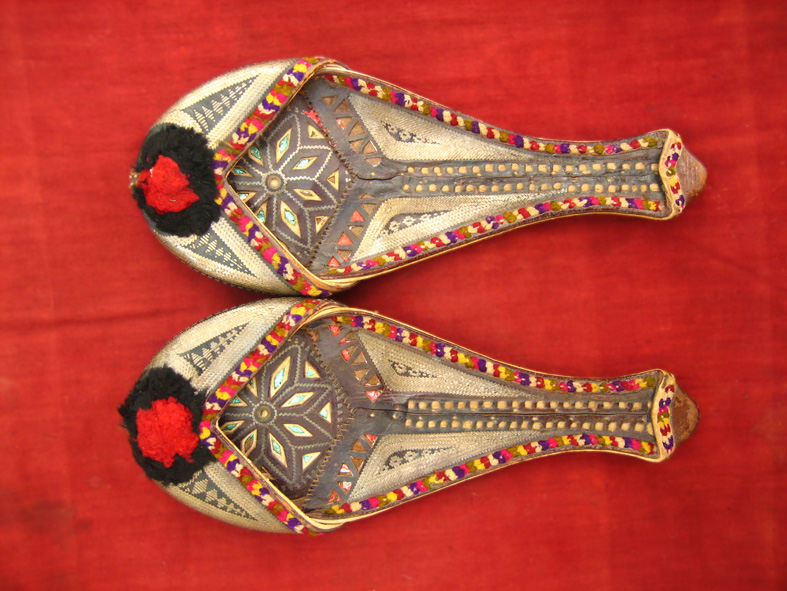
‘Mojaris’ are special kind of leather shoes. Mostly made using vegetable-tanned leather, uppers are made of one piece of leather or textile embroidered and embellished with brass nails, cowry shells, mirrors, bells and ceramic beads. Even the bonding from the upper to the sole is done by cotton thread that is not only eco-friendly but also enmeshes the leather fibers with great strength. Some product range also uses bright and ornate threads. [Source: Wikipedia]
 
                     Mojari shoes: Source: Wikimedia Commons [By Meena Kadri [CC BY 2.0
                      (http://creativecommons.org/licenses/by/2.0)], via Wikimedia Commons

Difference between 'Mojaris' and 'Jootis' / 'Juttis': Mojari is referred to a man's closed shoe with an extended curled toe, while as juttis have flat fronts. In juttis, rear is normally covered but mojari have an open look from behind.

Non-leather 'Jootis' made of synthetic material
Source: Wikimedia Commons [By MuLaN™ (Cropped from CIMG1455) [CC BY 2.0 (http://creativecommons.org/licenses/by/2.0)], via Wikimedia Commons]
 
Traditionally, rajput women wore Jootis while men wore Mojaris. Even today bridal jootis are worn with Poshaaks although modern heeled shoes have become quite common.
 
'Multani Khussa': A cross between Jootis and Mojaris i.e. mojaris which are not open from behind are known as 'Multani Khussas'. However, in India, the term 'jooti' is used for khussas.


'Multani Khussa' (popularly known as jooti in India)
Source: Wikimedia Commons [By Meena Kadri [CC BY 2.0 (http://creativecommons.org/licenses/by/2.0)], via Wikimedia Commons]


Monday, 17 August 2015

Rajputi jewellery: 'Thewa' jewellery

'Thewa' / 'Theva' jewellery involves embossing of intricately worked-out sheet gold on molten glass. It evolved in Pratapgarh district of Rajasthan India. According to the Wikipedia , Thewa is a traditional art of fusing 23K Gold with multicoloured glass. The glass is treated by a special process to have glittering effects, which in turn highlights the intricate gold work.  The process of making thewa work is detailed; time consuming and intricate, taking up to a month to complete each piece.


Thewa glass plate depicting two peacocks
Source: Wikipedia


The artwork on the glass plate is very intricate and Rajasthani in nature. The artists take immense pride in embossing forts, battlescenes and birds and animals of Rajasthan on the glass  plates. Depiction of peacocks, camels and elephants is very common.

Traditionally, thewa jewellery consisted of thewa glass plate (shown above) attached with matching beads to make necklaces and earrings. Todayy, the glass plate is used as a base to create all kinds of modern jewellery.

'Suhaag' jewellery is a term used for jewellery specifically gifted to a bride on her wedding. The woman continues wearing suhaag jewellery throughout her married life. It includes bichiya and aad.   However, thewa jewellery is not specifically associated with any occasion. One of the reasons could be the fact that unlike traditional gold jewellery, thewa art is relatively new. However, it has become extremely popular in Rajasthan, especially in Pratapgarh district and nearby areas. In fact, thewa cuff links, bracelets etc. are worn by men as well.

Friday, 14 August 2015

Rajputi jewellery: 'Bichiya' or toe rings and 'Paayal' / 'Paayejeb' or anklets

'Bichiya' or toe rings were traditionally worn only in the long toe after marriage. Also, unmarried women were forbidden to wear them as they signified consummation of marriage. Bichiyas or a pair of toe rings for the long toe are inevitably gifted to a woman on the eve of her wedding. In the picture, a toe ring is being worn on the day of the wedding.

Source: Wikimedia Commons [By Karthik Murugan (Own work) [CC BY-SA 3.0 (http://creativecommons.org/licenses/by-sa/3.0)], via Wikimedia Commons] 

This tradition is still followed religiously by Rajputs who prefer gold bichiyas instead of silver ones. A married woman is generally not supposed to take off toe rings worn in the long toe. She is free to wear toe rings in other toes as well.

'Paayal' / 'Paayejeb' are anklets and gold anklets are gifted to a bride along with the 'bichiyas'.

Woman wearing gold Paayal
Source: Wikimedia Commons [By Bollywoodaustralia [GFDL (http://www.gnu.org/copyleft/fdl.html) or CC BY-SA 3.0 (http://creativecommons.org/licenses/by-sa/3.0)], via Wikimedia Commons]

Thursday, 13 August 2015

Rajputi jewellery: 'Nath', 'Nathni' and traditional nose studs

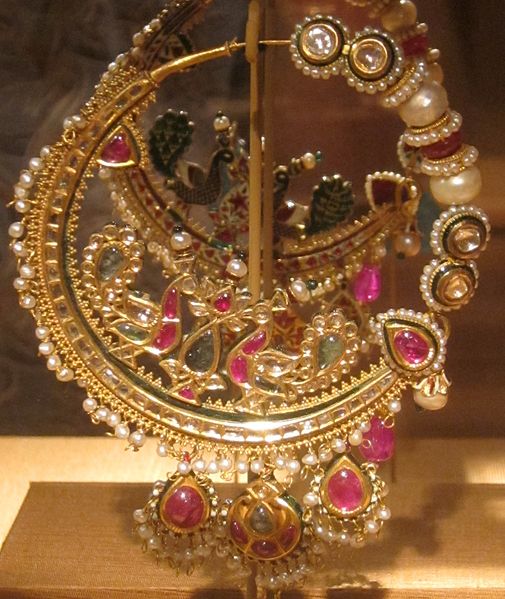
Traditional nose rings and nose pins of various sizes are popular in Rajasthan. Rajput women prefer gold nose rings / nose pins with studded diamonds or gemstones.

If the gold hoop ring covers the lips, the nose ring is known as a 'nath' while smaller ones are known as 'nathni'. However, these days the term 'nath' refers to all kinds of nose rings irrespective of the size. 

Small gold 'nathni' with studded diamonds


Traditional nath
Source: Wikimedia Commons [By Hiart (Own work) [CC0], via Wikimedia Commons]

The nath design shown above is depicted in the famous 'Bani Thani' paintings of Rajasthan and is extremely popular in Rajasthan. Shown below is the 'Bani Thani' painting of Rajasthan by Nihal Chand. 


'Bani Thani' wearing traditional nath


Often a string of pearls or gold is attached from the nath / nathni and pinned to the hair as shown below. 


[By Prakhar Amba from Grenoble, France (Bride) [CC BY 2.0 (http://creativecommons.org/licenses/by/2.0)], via Wikimedia Commons]

.Rajasthani nose studs: Traditional nose studs are made of gold with studded diamonds and other precious jewels. They  have intricate designs and are available in all shapes and sizes.

Source: Pinterest


Wednesday, 12 August 2015

Rajputi jewellery: 'Timaniya'

Timaniya / Tanmani / Trimani: So much confusion shrouds this piece of jewelry, that it deserves as separate post. This kind of jewellery known as 'Timaniya' in Rajasthan, 'Trimani' in Hyderabad and 'Tanmani' in Maharashtra. The term literally means 'three gemstones' and is derived from hindi words 'tri' (meaning three) 'mani' (meaning gemstones). This is exactly why it has evolved to refer to different kinds of choker necklaces these days.


Rajasthani Timaniya: Traditionally, the term 'Timaniya' was used for 'mini aad' or a choker which looks a lot like 'aad' as shown below. Please note that an  'aad' (much bigger than the mini aad) was never referred to as a 'timaniya' and the term timaniya was only used for a mini aad shown below.


Later, the term was applied to chokers made of uncut diamonds irrespective of whether they were designed like an aad. These were also known as 'tewta'.

Source: Pinterest

Timaniya, Tanmani and Trimani jewellery: As stated earlier, this kind of jewellery is also popular in Maharashtra, Hyderabad and other parts of India. In Maharashtra, it is known as 'Tanmani' and in Hyderabad it is known as 'Trimani' or 'Tirmani'.


Hyderabadi Trimani / Tirmani
Source: Pinterest
These days the terms 'timaniya', 'tanmani', 'tirmani' are used for small diamond pendants as shown below:

Therefore, if a jeweller ends up showing you small diamond pendants when you ask for a 'timaniya', don't complain. The term denotes all kinds choker necklaces and gemstone pendants these days.  

Tuesday, 11 August 2015

Rajputi jewellery: 'Hathphool'

'Hathphool' (aka 'Hathpanja in some other parts of India) is elaborate jewellery which adorns the back of the palm and the wrist. It consists of gold finger rings tied to a gold medallion with one or multiple strings and another string(s) attaches the medallion to a bracelet. The image below shows a traditional hathphool:

Woman wearing Hathphool jewellery
Source: Pinterest

Traditional Hathphool
Source: Wikimedia Commons [By Sodabottle (Own work) [CC BY-SA 3.0 (http://creativecommons.org/licenses/by-sa/3.0)], via Wikimedia Commons]
Shown above are traditional Hathphools popular among Rajputs. Hathphools are generally manufactured in gold. Kundan Hathphools are quite common as well. 

Many variations of Hathphools are also available. For instance,  every hathphool need not have five rings attached to its medallion. Hathphools consisting of a single ring or two to three rings are also quite popular. Some Hathphools do not have a medallion and the finger ring is attached directly to the bracelet with a string, as shown below. 

Source: Pinterest
Note this Hathphool has only one cocktail ring attached directly to the bracelet without the central medallion

Unmarried women generally do not wear Hathphools as it is gifted to a woman on the occasion of her wedding. Traditional Hathphool was a single piece of jewellery worn by a bride on her wedding.  Many modern jewellers now manufacture detachable hathphools (with detachable string) so that the ring and the bracelet can be worn without the string. 

Sunday, 9 August 2015

Rajputi jewellery: 'Pankhi haar'

'Pankhi' means a traditional fan with a handle as shown below. Pankhi jewellery is shaped to look like a pankhi. Pankhi necklace and earrings are increasing becoming popular among Rajput women as well.

Source: Indiamart
'Pankhi haar' or pankhi style necklace is especially popular in Rajasthan and Rajput women often wear it with Poshaaks and sarees. 


Pankhi haar
Source: Pinterest
Pankhi style earrings are also worn. 


Woman wearing Pankhi earrings and a Pankhi haar (partly visible)
Source: Pinterest

Pankhi  haar and earrings set: Pankhi style necklace and earrings
Source: Pinterest