Tuesday, 11 August 2015

Rajputi jewellery: 'Hathphool'

'Hathphool' (aka 'Hathpanja in some other parts of India) is elaborate jewellery which adorns the back of the palm and the wrist. It consists of gold finger rings tied to a gold medallion with one or multiple strings and another string(s) attaches the medallion to a bracelet. The image below shows a traditional hathphool:

Woman wearing Hathphool jewellery
Source: Pinterest

Traditional Hathphool
Source: Wikimedia Commons [By Sodabottle (Own work) [CC BY-SA 3.0 (http://creativecommons.org/licenses/by-sa/3.0)], via Wikimedia Commons]
Shown above are traditional Hathphools popular among Rajputs. Hathphools are generally manufactured in gold. Kundan Hathphools are quite common as well. 

Many variations of Hathphools are also available. For instance,  every hathphool need not have five rings attached to its medallion. Hathphools consisting of a single ring or two to three rings are also quite popular. Some Hathphools do not have a medallion and the finger ring is attached directly to the bracelet with a string, as shown below. 

Source: Pinterest
Note this Hathphool has only one cocktail ring attached directly to the bracelet without the central medallion

Unmarried women generally do not wear Hathphools as it is gifted to a woman on the occasion of her wedding. Traditional Hathphool was a single piece of jewellery worn by a bride on her wedding.  Many modern jewellers now manufacture detachable hathphools (with detachable string) so that the ring and the bracelet can be worn without the string. 

Sunday, 9 August 2015

Rajputi jewellery: 'Pankhi haar'

'Pankhi' means a traditional fan with a handle as shown below. Pankhi jewellery is shaped to look like a pankhi. Pankhi necklace and earrings are increasing becoming popular among Rajput women as well.

Source: Indiamart
'Pankhi haar' or pankhi style necklace is especially popular in Rajasthan and Rajput women often wear it with Poshaaks and sarees. 


Pankhi haar
Source: Pinterest
Pankhi style earrings are also worn. 


Woman wearing Pankhi earrings and a Pankhi haar (partly visible)
Source: Pinterest

Pankhi  haar and earrings set: Pankhi style necklace and earrings
Source: Pinterest

Rajputi jewellery and dresses: 'Moriya' or peacock style jewellery and prints

'Moriya' (hindi term for peacock') print on chiffon poshaaks as well as 'moriya' style jewellery is very popular among Rajput women.

The peacock is the national bird of India and has always been associated with Rajasthani culture and has inspired artists from times immemorial. Many popular folk songs are about peacocks such as 'moriya aacho bolyo re dhalti raat maan', 'Mor bolyo re aabu re pahdaan main'.

Rajputi jewellery has been modeled to depict peacocks. Earrings, aads, necklaces, bangles, rings and even anklets and toe rings depict peacok motifs. Such style of jewellery is known as 'moriya' style jewellery.

'Moriya' style aad
Source: Pinterest

Moriya style earrings
Source: Pinterest

Moriya style kada
Source: Pinterest
Moriya print on a Poshaak

Rajputi jewellery: 'Rakhdi', 'Sheeshphool' / 'Sheeshpatti' and 'Khaancha'

'Rakhdi' (also known as 'borla' or 'bor') is hair jewellery worn by Rajputs. It is a round piece of jewellery which is worn at the centre of the forehead, at the hairline as shown below. A thread or string is attached to the jewellery which is pinned and tied to the hair.

Rakhdi jewellery
Source: Pinterest

'Sheeshphool' Along with rakhdi, additional headgear or jewelled head band is worn known as 'sheeshpatti' or 'sheeshphool' (see image below).

Woman wearing Rakhdi and Sheeshphool
Source: Pinterest


Two or more sheeshphools are also worn with the Rakhdi as shown below:

Woman wearing two sheeshphools with a Rakhdi
Note that sheeshphools are detachable headbands worn at least an inch away from the hairline
Source: Pinterest 


The terminology for the headband can be a bit confusing as 'sheesh' (hindi term for head), phool (hindi term for 'flower') should ideally denote the round rakhdi itself and not the hairband. On the other hand 'patti' means 'band' so 'sheepatti' literally means 'head band'. However, 'sheeshphool' and 'sheeshpatti' are interchangeably used to denote the headband itself.

Difference between 'mang teeka' and 'rakhdi': A mangteeka is a flat headpiece and not a round ball like 'rakhdi' which can be worn in place of Rakhdi. See image below:

Juhi Chawla wearing a Mangteeka
Rajput women prefer Rakhdi to Mangteeka

Difference between 'sheeshpatti' and 'mathapatti': As explained above, 'sheeshpatti' literally means headband. So it is worn over the head but further from the hairline - the hairline is clearly visible as it is worn an inch further from the hairline over the head. However, the more popular 'mathapatti' is a band covers the hairline itself as shown in the image below.


              Woman wearing Mangteeka and Mathapatti
        Rajput women prefer Rakhdi and Sheeshphool to Mathapatti and Mangteeka


Rajput women generally wear rakhdi and sheeshpatti and hardly wear 'mang teekas' with / without 'mathapattis'.

'Khaancha' jewellery: However, a variation of mathapatti which adorns the rakhdi (and not a mang teeka) is known as 'khaancha'. 'Khaancha' literally stands for 'container to maintain shape' and is attached to the rakhdi (unlike mathapatti and sheeshphool which are detachable). It adorns the rakhdi as shown below:


'Khaancha' jewellery attached to the Rakhdi
Source: Blogger (Rajasthani jewellery blog work)


Rajput woman wearing Rakhdi with Khaancha and Sheeshphool


Wednesday, 5 August 2015

Traditional Rajputi dress: 'Rajputi Poshaak'

Rajputi Poshaak is a traditional dress worn by Rajput women.

Rajput women prefer poshaaks to sarees and wear them routinely as well as on festive occasions. On festive occasions, poshaaks made of chiffon material are worn.

A poshaak consists of two tops, a skirt and a long dupatta  known as 1.5 patti dupatta. There is a blouse with elbow sleeves known as 'kaanchli' and a straight cut sleeveless kurta (long enough to cover the navel and longer than lower waist as well) known as 'kurti' (see image below).

The kurti is worn over the kanchli and only sleeves of the  kanchli are visible. The dupatta is draped exactly in the style seen in this picture.


Tuesday, 4 August 2015

Rajputi Jewellery: Bangles: 'Bangadi', 'Gokharu', 'Gajara', 'Paunchi' and 'Pacheli' bangles

Traditional Rajputi bangles are of different types such as 'bangadi', 'gokharu', 'gajara bangle', 'pahunchi or ponchi', 'pacheli'. Many jewellers and sources use the terms interchangeably but traditionally, all the styles were quite distinct as illustrated below.

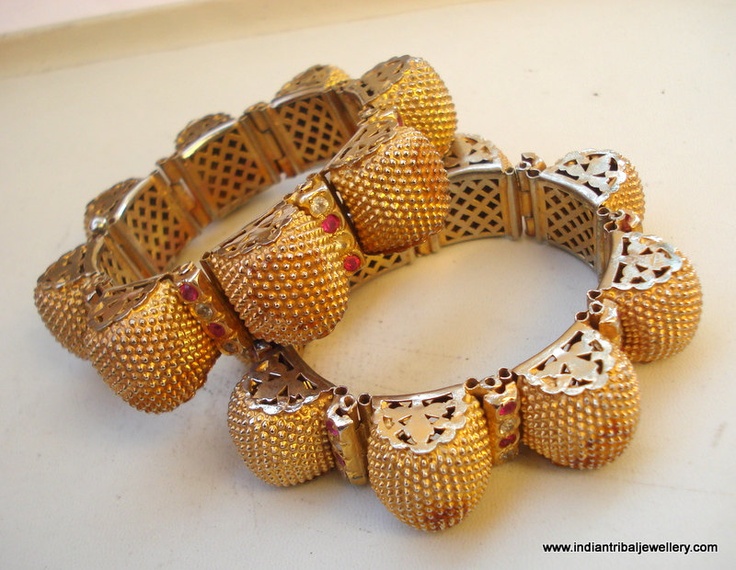
"Bangadi / Bangdi" are a special kind of (set of two) bangles worn by Rajput women on their weddings. A bangadi is a round bangle with thick lining and small round gold protrusions all around it which makes it quite wide in diameter as shown below. Note that the gold protrusions must necessarily be shaped like a round ball and affixed exactly in the manner shown below. Furthermore, the bangle must not have a clasp or it would be a bangadi like kada and not a traditional bangadi bangle. Unmarried Rajput women do not generally wear a bangadi (they may wear gokharus, paunchis or other styles) as it is generally gifted to a woman on her wedding.

A 'Bangadi' bangle
Source: Pinterest
Since the independence, a combination of plastic and gold became very popular in Rajasthan. Many  bangadis were manufactured in the style shown below:


Traditional Rajputi plastic and gold Bangadi
Source: Pinterest

However, many variations of bangadi are available these days. For instance, many jewellers experiment with the protrusions and use a combination of gold and diamond as well. Modern style bangadis are commonly referred to as 'Pacheli' bangles erroenously (see below).

Variation of the traditional Bangadi (also known as 'Pacheli')
Source: Pinterest: 

Gokharu style bangles:  A 'gokharu' is a kada style bangle which is much smaller in diameter but thicker than a bangadi. Furthermore, it has large cubical gold protrusions (as against small round balls in a bangadi).

Difference between a 'Gokharu / Gokhru' and a Bangadi: 'Gokharu' style bangles and bangadis are not similar at all. Much smaller in diameter and look, a gokharu (see image below) can hardly be confused with a bangadi
Gokharu bangle 
(It is not made of white pearls. If white pearls are used, it is known as 'Gajara' / 'Gajra' bracelet)
Source: Pinterest


Variation of Bangadi aka Pacheli  (see post below)
This image is of an anklet but can be used to illustrate modern Pacheli style bangles
Source: Wikimedia Commons [By Daderot (Own work) [CC0], via Wikimedia Commons]

The picture shown below shows both traditional bangadis and a gokharu. The woman is wearing two bangadis (two outermost bangles) and one thick gold Gokharu bangle.
Two gold Bangadis and one gold Gokharu
Source: Pinterest

'Gajra' / 'Gajara' bracelet or bangle: A gokharu bangle made of pearls is known as a 'Gajara' or 'Gajra' bracelet. Jasmine flowers worn in hair  are known as 'Gajra'. The pearl gajara bangle / bracelet derives its name from the string of white jasmine flowers.

Difference between Gokharu bangle and Gajara bracelet: Note that unless made of white pearls and with protrusions as shown here, the bangle / bracelet would not be called a 'gajara' / 'gajra' bangle but 'gokharu' instead. Given below is a gajara bangle.

   Gajara / Gajra bangle 
Source: Pinterest

The image shown below shows a modern bangadi (outermost bangle) and gajara bangle.


Woman wearing modern Bangadi and a Gajara bangle

'Pahunchi' 'Paunchi' bracelet: A paunchi is a bracelet (not a bangle) in the form of a rakhi. It consists of small gold protrusions of a bangadi (not of gokharu) embossed to a rectangular base wide enough to cover the upper wrist. It is tied by two threads to the wrist is therefore, neither a bangle nor a kada.


Paunchi or Pahunchi (rakhi style jewellery: not to be confused with kada, bangle or bracelet)


Pacheli bangle: A pacheli bangle is a combination of a bangadi, gokharu and sometimes even ponchi. It is a a kada style bangle with a clasp. it is much smaller in diameter than a bangadi. Furthermore, the round gold protrusions are not present. Instead, diamond, pearl or combination protrusions adorn the outer circumference of the bangle. However, many jewellers erroneously refer to modern style bangadis as pacheli.


Pacheli bracelet
Source: Pinterest

As stated above, combination of traditional styles are also available these days and are referred to as 'Pacheli' and erroneously even as 'bangadi' or 'gokharu'. Shown below is a bangle which is a variation of bangadi: It is actually a combination of a paunchi (it is tied with a string) and gokharu (large protrusions instead of small gold ones).
Modern combination Rajputi jewellery
Source: Pinterest

Monday, 3 August 2015

Rajputi jewellery: Set of three necklaces ('Ranihaar', 'चिक necklace' and a 'shorter Rani haar' necklace)

Many Rajput women are gifted a set of three pearl necklaces and long earrings on their weddings. The longest one is known as the 'Ranihaar' and the shortest collar / choker necklace is known as "चिक" (prononced 'chick') necklace. There is also a shorter Ranihaar which in many cases, is exactly like the longest one: only the length varies.

Ranihaar: "Rani haar" literally means queen's necklace. It is a long necklace (longer than opera but can be shorter or longer than lariat or rope depending on the preference) worn by women of various communities.

Traditional Rajputi Ranihaar is a necklace made of three to six strings of pearls which hold a large pendant as shown below. A variation of Ranihaar known as "Satlada" is a Mughal style necklace but is hardly worn by Rajput women in general. The picture below shows a traditional Rajputi Ranihaar but her hand is overshadowing the pendant. The second image shows the Ranihaar and earrings.

Traditional Ranihaar
Source: Pinterest


Ranihaar with pearl gold earrings
Source: Indiamart

"चिक"  or "chick" necklace: As stated, three similar necklaces of varying lengths are popular among Rajputs. The shortest one is a collar (sometimes choker) necklace known as "चिक"  or "chick" necklace as shown below:

'Chick' necklace
Source: Pinterest

The 'chick' necklace can be worn by unmarried women and children. However, in most cases, Ranihaar is gifted to a woman only at the time of her wedding. Also, traditional Rani haar is always made of white pearls but this is not necessarily the case with the "chick" necklace. The term "chick" necklace now refers to any choker / chollar necklace which holds a small pendant.

The set of three necklaces and earrings are shown below:


Complete set of three necklaces  and earrings
(Ranihaar, 'chick' necklace and third medium necklace with earrings)
Source: Photo-bugs